
Developing the cocoon lamp
Fritz "Friedel" Wauer, often hailed as the progenitor of Cocoon lamps, had a fateful encounter in his modest tobacco shop in Wuppertal. It was in 1937 when a casual conversation with a cigar aficionado, who happened to be a manufacturer of lampshade wire frames, sparked an idea within Fritz. Promptly seizing the opportunity, by the year's end, he initiated the production of pleated lampshades in Cologne-Nippes.
The ravages of war dealt blows to both Fritz's tobacco business and the lampshade enterprise. However, undeterred by adversity, Fritz resurrected his lampshade venture shortly after the war. Utilizing a batch of parchment paper stumbled upon in Wuppertal, he once again found success, aided in no small part by his own patented innovation: a semi-automatic machine for crafting tension-free metal frame components.

American war equipment was "cocooned" to protect it
In 1952, a pivotal moment unfolded as Fritz stumbled upon an article in the "Generalanzeiger." The piece featured a machine coated with thread-forming plastic, resembling a protective "skin" used by the Americans to safeguard their war equipment during overseas transport.
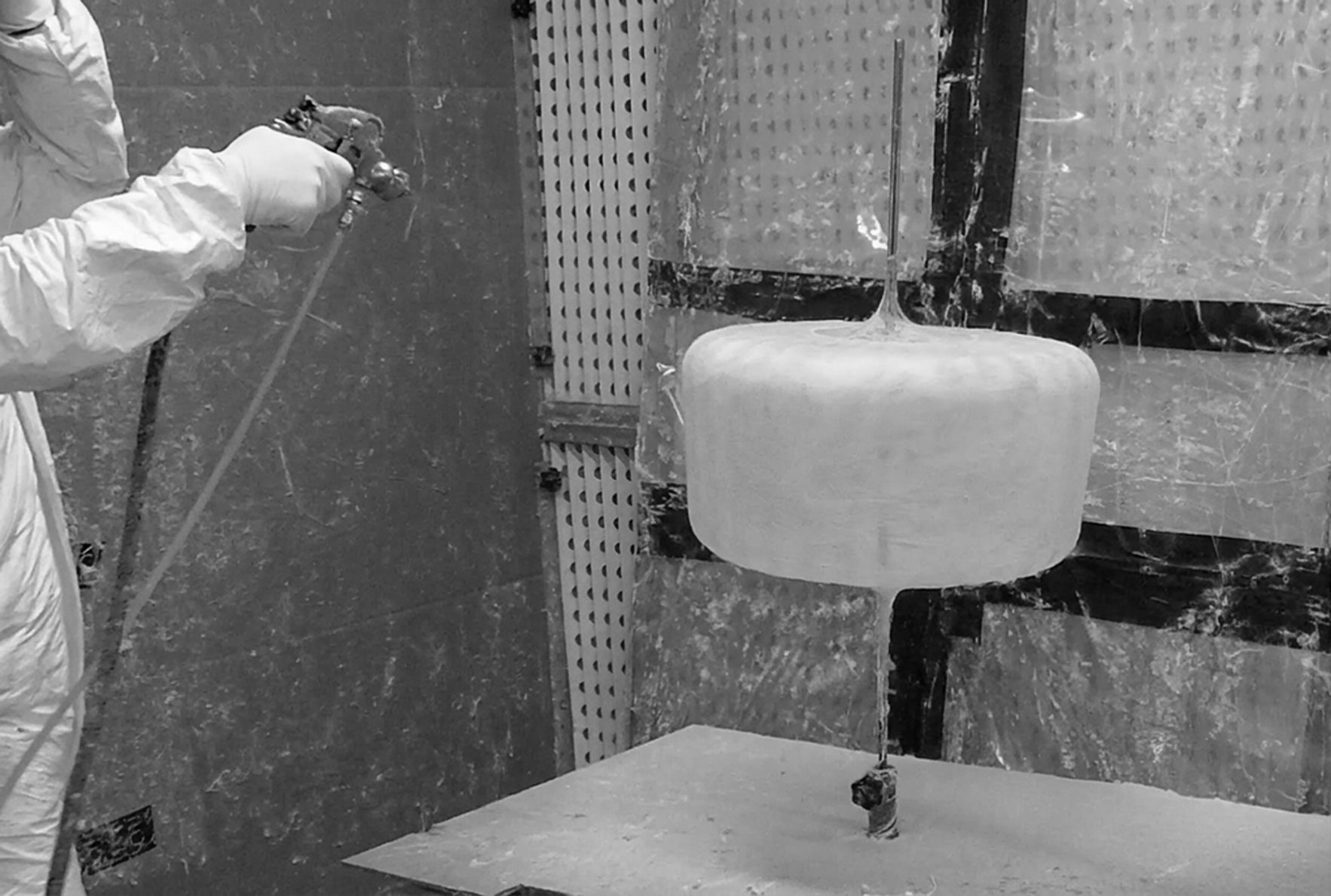
Intrigued by this revelation, Fritz embarked on a journey of experimentation. Ultimately, his endeavors bore fruit: a rotating wire frame, sprayed with liquid thread, solidified instantaneously, weaving a mesmerizing, white-transparent lampshade with an ever-shifting structure, exuding a unique allure. Thus was born Fritz Wauer's trademarked innovation: Cocoon.

Strands of cocoon material is sprayed onto a rotating wire frame
Initially met with lukewarm reception, white lights experienced a surge in demand in the mid-1950s, coinciding with the Scandinavian furniture trend. Consequently, Cocoon began to weave its magic, and the "white dream" became a sensation, selling like proverbial hotcakes. The appeal of Cocoon lights lies not only in their aesthetic charm but also in their practical advantages: seamless construction, resistance to breakage and tearing, enduring elasticity, heat and color resistance, washability, and even light diffusion.
The allure of Cocoon lights has endured for more than seven decades, a testament to its enduring appeal within the industry.
Fritz Wauer's legacy is extensive within the realm of Cocoon lamps; he went on to design over 400 foundational models in approximately 1000 variations, encompassing a spectrum from modern to traditional designs, always with a focus on interior spaces and the art of living.
His innovative material found favor not only in homes but also in commercial settings, adorning kindergartens, schools, hospitals, offices, hotels, and restaurants.

Newly sprayed cocoon lamps drying
Fritz Wauer, affectionately known as "Friedel" among friends, carved his niche as the "father of the Cocoon process in the lighting industry." His pioneering spirit and creative vision endowed the industry with a diverse array of wire frame productions and groundbreaking collections, leaving an indelible mark on the world of lighting design.
At Novoform, we work closely with Fritz Wauer’s heirs to relaunch a selection of chosen designs from the extensive back catalogue of Cocoon lamps. This is in part done in close collaboration with a long-established lighting manufacturer in Northern Italy, which also produced the lamps under license back in the 1960s.
Feeling inspired? Discover the Cocoon-lamp collection